
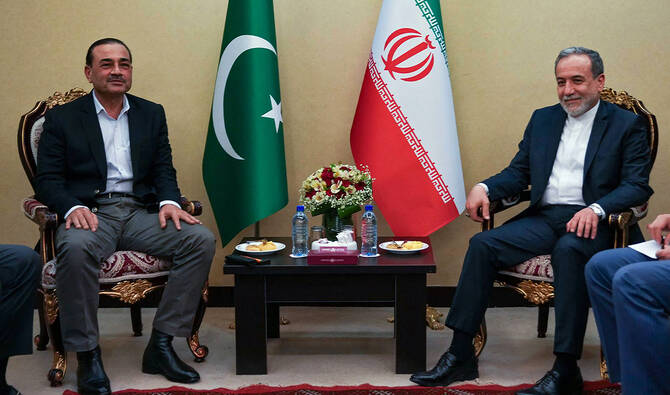
Pakistan’s Chief of Defence Forces and Chief of Army Staff, Asim Munir, held extensive discussions with Iranian Foreign Minister Abbas Araghchi in Tehran regarding ongoing diplomatic efforts to reduce tensions and bring an end to the conflict in the Middle East.
Image: Arab News PK
According to an official statement shared by the Iranian government on X, the meeting focused on initiatives aimed at preventing further escalation and promoting peace, stability, and security across West Asia.
Iran’s ISNA news agency reported that the talks between Field Marshal Asim Munir and Abbas Araghchi continued late into the night, during which both sides reviewed recent diplomatic developments and discussed ways to end what Iran described as a war imposed by the United States and Israel.
Field Marshal Asim Munir arrived in Tehran on Friday evening at a time when international diplomatic activity surrounding the conflict had intensified. Iran is currently reviewing a new peace proposal as efforts continue to avoid further military confrontation.
Iranian Foreign Ministry spokesman Esmaeil Baqaei stated that despite ongoing negotiations, major disagreements still remain. He clarified that the latest talks should not yet be viewed as a decisive breakthrough.
Meanwhile, US Secretary of State Marco Rubio expressed cautious optimism about progress in negotiations aimed at ending the war, which began on February 28 following joint US-Israeli strikes on Iran. The conflict has disrupted shipping around the Strait of Hormuz, creating instability in global energy markets and increasing oil prices.
Although negotiations have continued since an April 8 ceasefire — including direct talks hosted in Islamabad — no permanent agreement has been reached so far, and full access to the strategic waterway has yet to be restored.
US President Donald Trump described the ongoing negotiations as being on the edge between achieving a deal and facing renewed military action. Reports from US media outlets suggested the White House was considering possible strikes, though no final decision had been made.
Sources said Field Marshal Asim Munir’s visit to Tehran was part of Pakistan’s continuing mediation efforts. He was received by Iranian Interior Minister Eskandar Momeni alongside Pakistan’s Interior Minister Mohsin Naqvi, who has recently made multiple visits to Iran for meetings with senior Iranian leadership.
Iranian officials acknowledged that several countries are trying to help end the conflict, but maintained that Pakistan continues to serve as the official mediator in the process.
During the discussions, Abbas Araghchi said Iran remained committed to diplomacy despite what he described as repeated violations of trust by the United States and continued military pressure against Iran. He added that Tehran was approaching negotiations seriously and hoped to achieve a fair and balanced outcome.
Speaking during a NATO meeting in Sweden, Marco Rubio noted that some progress had been achieved but warned that negotiations remained difficult. He said President Donald Trump still preferred a diplomatic solution, although Washington continued to keep other options open if talks failed.
Tensions surrounding the Strait of Hormuz remain a major concern after Iran effectively restricted passage through the vital route in response to US-Israeli military actions. Since the strait handles a significant portion of global oil shipments, fears are growing over the long-term impact on the world economy and energy supplies.
Iranian officials confirmed that discussions are also covering the future of the Strait of Hormuz, the US blockade of Iranian ports, and broader regional tensions, including the situation in Lebanon.