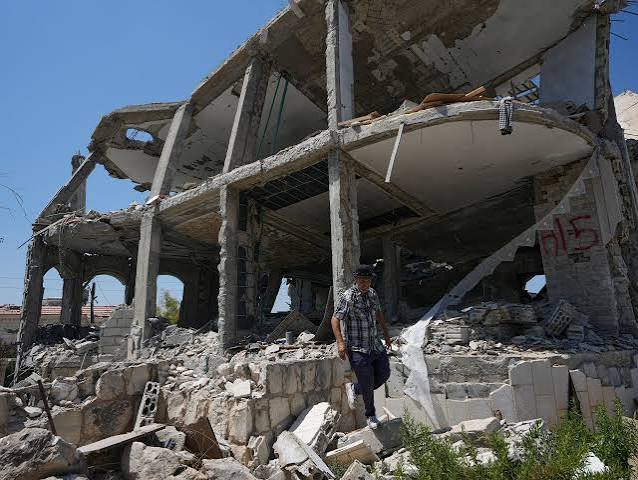

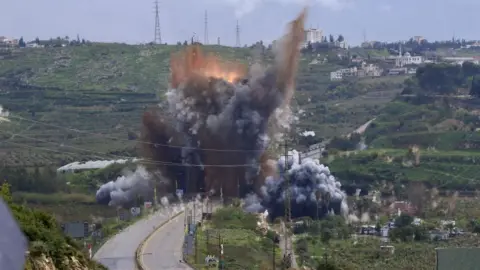
Israel carried out fresh airstrikes across parts of Lebanon late Saturday, hours after earlier attacks reportedly killed 10 people, according to Lebanese authorities and local media reports.
Image: BBC
Lebanon’s state-run National News Agency said Israeli warplanes launched five strikes near the mountainous Nabi Sreij area on the outskirts of Brital, close to the Syrian border. The region had largely avoided attacks since the April 17 ceasefire agreement between Israel and Hezbollah.
An AFP correspondent in the southern city of Tyre reported hearing two explosions after buildings on the outskirts and inside the city were struck, sending heavy smoke into the air.
Before the strikes, rescue workers and municipal police used loudspeakers to urge residents to evacuate the targeted neighbourhoods.
The Israeli military had earlier issued evacuation warnings through Arabic-language military spokesman Avichay Adraee. Residents of the Lebanese village of Burj Rahal and two districts in Tyre were instructed to leave the areas, with Israel claiming Hezbollah facilities were located nearby.
Lebanon’s Health Ministry stated that Israeli strikes on Friday killed 10 people, including six rescue workers and a child.
According to the ministry, six people died in a strike on Deir Qanun al-Nahr village near Tyre. Among the victims were two members of the Risala Scouts association, which is linked to the Hezbollah-allied Amal movement, as well as a Syrian girl.
Another strike on the southern town of Hanaway reportedly killed four rescue workers affiliated with the Hezbollah-linked Islamic Health Committee.
Separately, the Israeli military announced that it had killed two armed individuals near the Lebanese border early Friday. In a statement posted on Telegram, the military said surveillance teams spotted the suspects moving suspiciously close to Israeli territory before they were targeted in an airstrike.
Meanwhile, Hezbollah claimed responsibility for attacks targeting Israeli troops and military positions both inside Lebanon and across northern Israel near the border.
Mohammad Raad, head of Hezbollah’s parliamentary bloc, accused Israel of intensifying attacks against civilians after failing to weaken Hezbollah fighters on the battlefield. He also repeated the group’s opposition to direct negotiations between Israel and Lebanon.
The developments came shortly after the United States announced sanctions against nine individuals linked to Hezbollah, accusing them of obstructing Lebanon’s peace process. The sanctions included two Lebanese military officers allegedly accused of sharing information with the group.
Despite the April 17 ceasefire, Israel has continued airstrikes, demolition operations, and evacuation orders in southern Lebanon, saying it is targeting Hezbollah infrastructure. Hezbollah has also continued launching attacks.
The current escalation intensified after Hezbollah fired rockets into Israel on March 2, saying the move was retaliation for the killing of Iran’s supreme leader during joint US-Israeli strikes.
Israel later responded with large-scale airstrikes and a ground operation in southern Lebanon, where Israeli forces remain active within a self-declared “yellow line” zone extending several kilometres into Lebanese territory.
Lebanon’s Health Ministry says Israeli attacks have killed at least 3,111 people since the broader regional conflict began, while the Israeli military says 22 of its personnel have died during the fighting.
Last week, the fragile ceasefire between both sides was extended for another 45 days following a third round of direct talks held in Washington between Lebanese and Israeli representatives — negotiations strongly opposed by Hezbollah.