

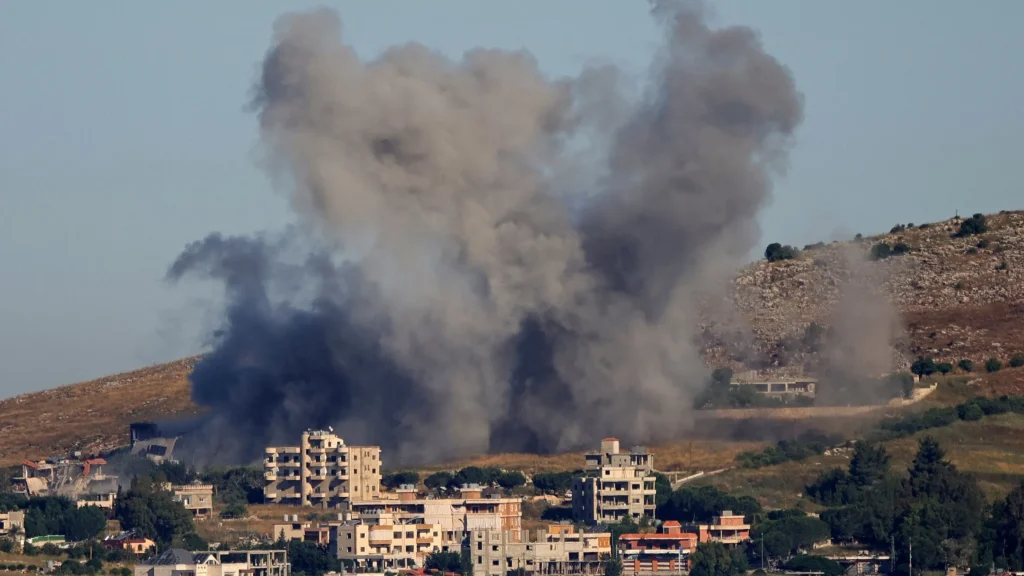
Israeli airstrikes struck several locations in southern Lebanon on Thursday, just hours after Israel and Lebanon announced an agreement to implement a conditional ceasefire following US-mediated talks in Washington.
Image: The Times
According to Lebanon’s state-run National News Agency (NNA), Israeli drones targeted roads in multiple southern areas, with at least one strike causing casualties. The exact number of victims was not immediately confirmed.
Earlier in the day, the Israeli military reported that air raid sirens had sounded in northern Israel. It said one alert was triggered by a “suspicious aerial target,” while another was later determined to be a false alarm.
The latest developments came after a fourth round of negotiations in Washington, where Israeli and Lebanese representatives agreed to move forward with a ceasefire arrangement. A joint statement said the deal requires a “complete cessation” of attacks by the Iran-backed Hezbollah group.
As part of the agreement, both sides also agreed to establish pilot zones in southern Lebanon where the Lebanese Armed Forces would exercise exclusive control, preventing the presence of any non-state armed groups.
However, the ceasefire faced criticism from within Israel. National Security Minister Itamar Ben Gvir described the agreement as a “serious mistake.”
Before the ceasefire announcement, Hezbollah claimed responsibility for launching rockets at Israeli troops and military vehicles in the Qantara area of southern Lebanon, as well as drone attacks near the strategic Beaufort Castle.
A previous ceasefire announced in April failed to hold, with both Israel and Hezbollah accusing each other of repeated violations. According to Lebanese authorities, Israeli attacks have killed more than 3,500 people since the conflict escalated in March. The World Health Organization recently reported that over 600 people have died in Lebanon since the April truce was announced.
Hezbollah officials have repeatedly stated that the group would not accept a partial ceasefire, raising concerns about the durability of the latest agreement.